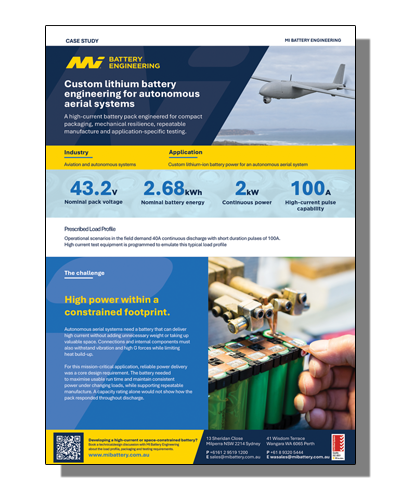
Australia • Aviation / Defence
Nominal pack voltage
Nominal battery energy
Continuous power
High-current pulse capability
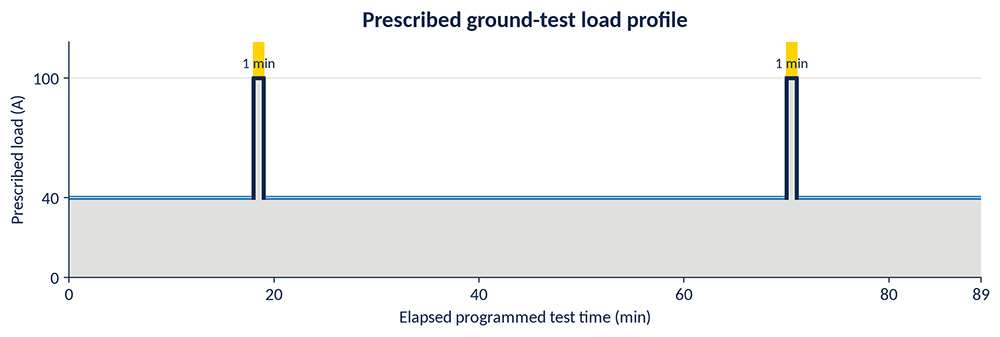
Nominal pack ratings. The prescribed ground-test programme is not a measure of flight endurance.
High power within a constrained footprint.
For this mission-critical autonomous aerial application, the battery had to deliver consistent high current and maximise usable run time within tight space and weight limits. Connections and internal components needed to withstand vibration and high G forces while limiting heat build-up.
The design also needed to support repeatable manufacture. A nominal capacity rating alone would not show how the pack responded throughout discharge.
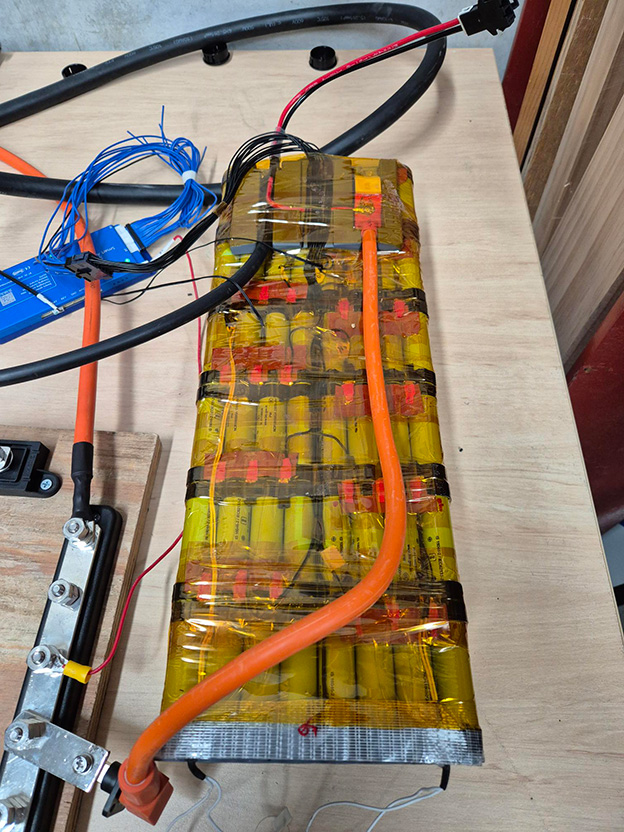
A custom pack, designed through to production.
MI Battery Engineering designed a custom lithium-ion pack with purpose-made cell spacers, laser-cut intercell connections and high-reliability connectors. Purpose-designed 3D-printed insulating plates protected the assembly and provided insulation and shock absorption.
Several prototypes refined current delivery, weight and the internal arrangement. New automated welding equipment and laser-cut links supported tight tolerances and repeatable assembly for high-current and high-G loads. In-process tests and work instructions prepared the pack for higher-volume production, with procedures refined as the design matured. High-performance 3D-printing materials were also evaluated.
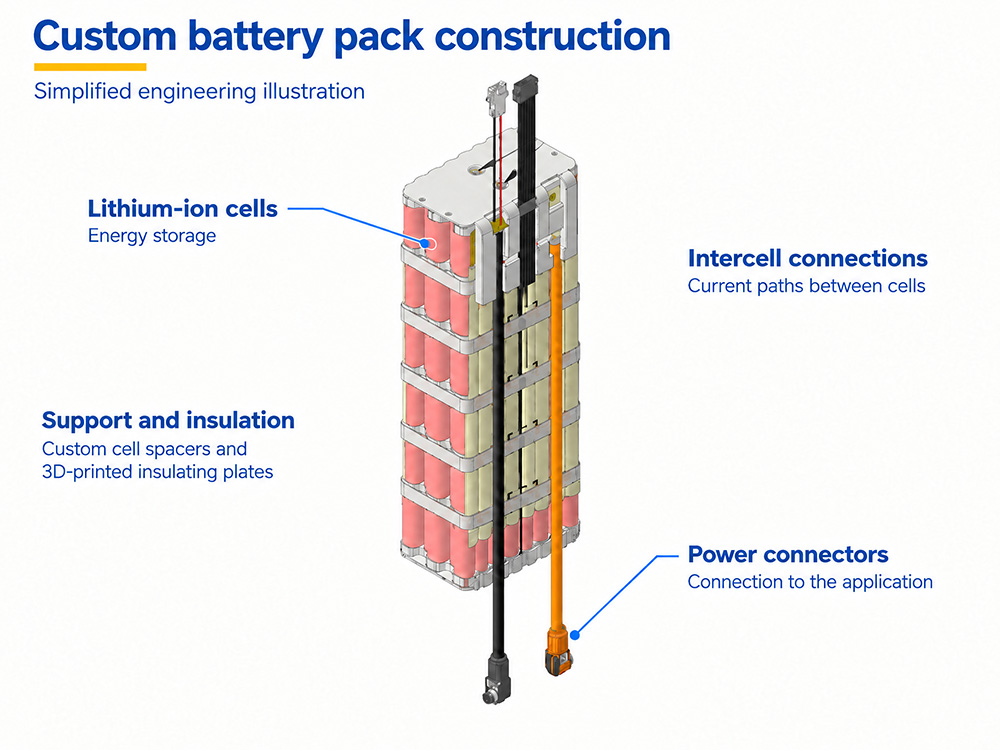
Simplified engineering illustration adapted from the supplied graphic, not assembly instructions.
| Subsystem | Equipment | Configuration |
|---|---|---|
| Energy storage | Custom lithium-ion battery pack | 43.2 V nominal • 2.68 kWh nominal |
| Cell arrangement | High-rate lithium-ion NMC cells • 216 × 18650 | 12S18P • 12 series groups, 18 cells in parallel per group |
| DC output | Custom pack power connections | 4 kW continuous • peaks up to 5 kW |
| Welding and interconnects | Laser-cut links • new automated welding equipment | High-current paths • high-G-load requirements • tight tolerances and repeatable weld positioning |
| Internal support | Custom cell spacers | Pack-specific cell positioning |
| 3D printing | Purpose-designed insulating plates | Insulation and shock absorption |
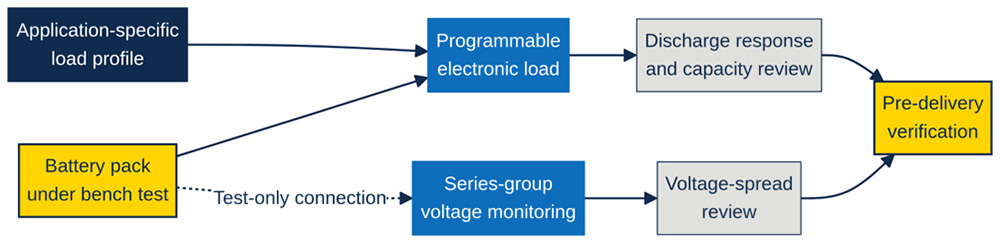
| Bench load testing | Precision bidirectional electronic load | Application-specific profile • 40 A stages • 2 × one-minute 100 A pulses • 89-minute programme |
| Test monitoring | Logging through a temporary smart BMS | Series-group voltage logging • bench use only, not installed in the application |
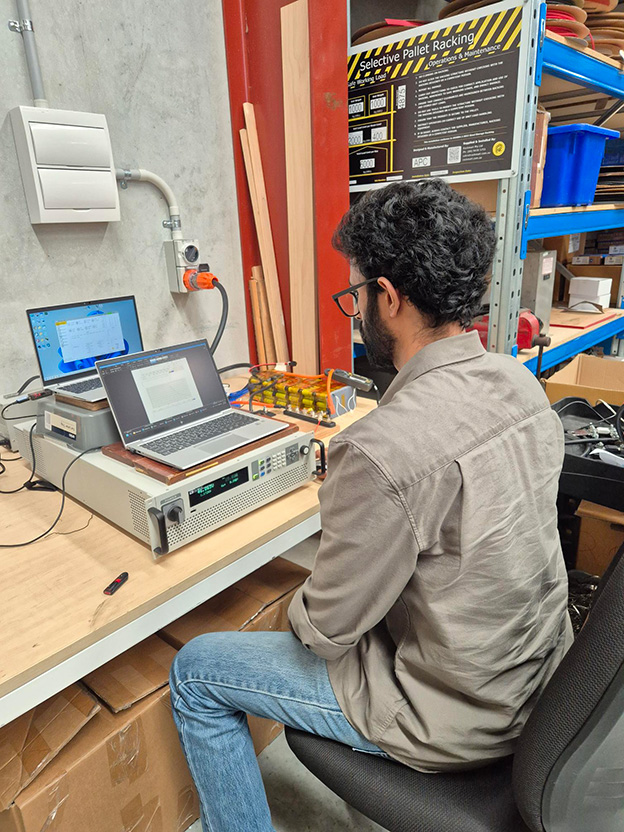
Checking voltage balance under load.
The project prompted purchase of a precision bidirectional electronic load to reproduce the customer-specified profile. A temporary smart BMS logged cell-group voltages throughout discharge to identify underperforming groups and check the required tight voltage-spread tolerance.
Real-time discharge and voltage-balance checks provided a more useful view than nominal capacity alone, with evidence of performance compliance before delivery. Packs were supplied with cells balanced and capacity verified. BMS monitoring was for bench testing only, not installed in the application.
Built for performance, repeatability and local support.
High-current performance
Prototyping improved current delivery, with pulse capability reported at over 100 A. Pre-delivery testing checked capacity and voltage behaviour against the specified profile.
Mechanical performance and weight
Prototyping improved shock and vibration resistance and reduced pack weight. 3D-printed components provided insulation and shock absorption.
Production readiness and efficiency
Work instructions and in-process tests prepared the pack for higher-volume production. Procedures improved assembly accuracy and repeatability, with efficiencies reducing production cost.
Sovereign engineering capability
Australian design, assembly and testing supported security requirements, local troubleshooting and supply reliability. Local changes helped manage risk and lead times.
Responsive design support
Collaboration and field feedback informed design revisions as specifications evolved. Local engineering supported rapid changes to meet new requirements and project milestones.
Investment in testing and materials
The project prompted new test equipment and evaluation of high-performance 3D-printing materials, strengthening assembly repeatability and accuracy.