Exmouth, Western Australia • Off-grid solar power and water treatment
Continuous three-phase power
Usable lithium storage
Solar generation capacity
Redundant battery management
In remote applications, reliability has to be engineered into the system.
Remote infrastructure depends on reliable power for critical loads, often in places where technical support is not immediately available.
For this remote Exmouth application, the requirement was to deliver resilient off-grid power within a compact 20-foot container. The system needed to provide continuous three-phase power, integrate solar generation, support on-board water treatment and remain dependable where specialist support may take days to reach site.
One system, coordinated around the load.
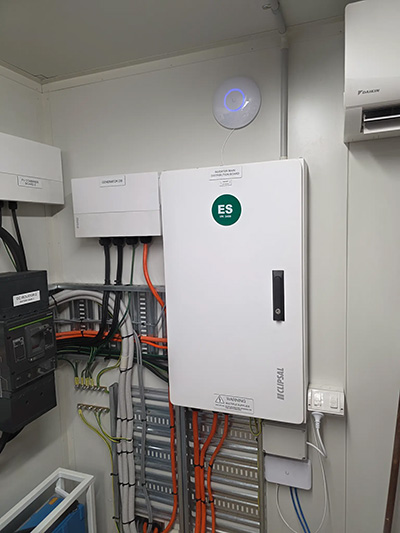
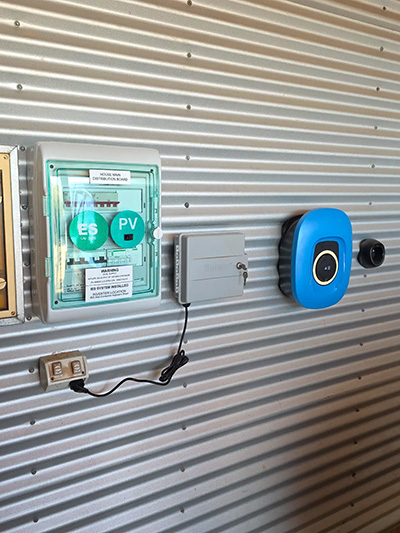
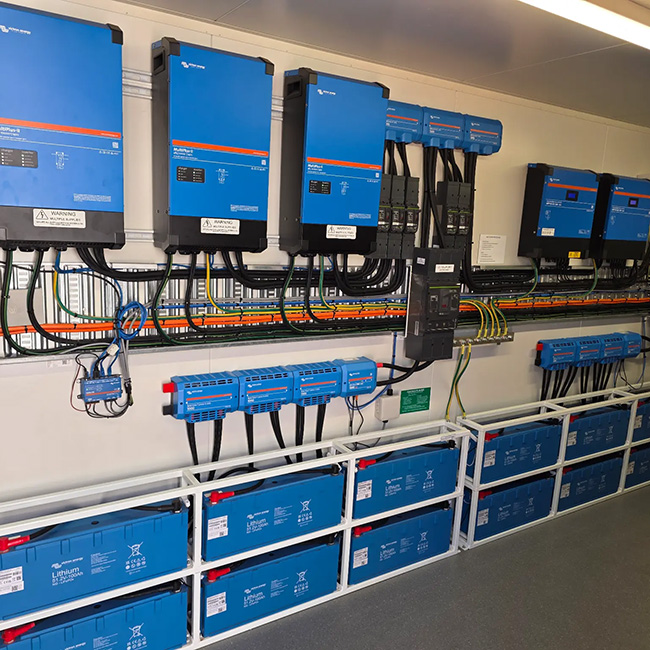
MI Battery Engineering developed the reference design for a standalone three-phase power system that integrates solar generation, lithium energy storage, grid and generator inputs, control and protection within a 20-foot container.
Three Victron MultiPlus-II inverter/chargers operate as a single 400 VAC, three-phase set, supported by twin MPPT controllers and a Cerbo GX for system supervision through VE.Can and VE.Bus communications. The container also incorporates a membrane-filtration water-treatment skid, creating a self-contained solution for power and water treatment.
Designed by MI Battery Engineering. Built and commissioned with Mining Industrial Electrics.
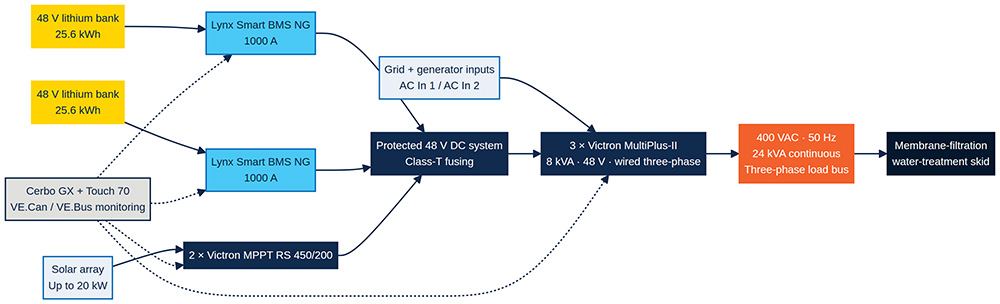
Illustrative high-level architecture. Refer to approved engineering documentation for detailed system design.
| Subsystem | Equipment | Configuration |
|---|---|---|
| Inverter / charger | 3 × Victron MultiPlus-II | 8 kVA • 48V • Three-phase |
| Battery management | 2 × Lynx Smart BMS NG 1000A | Redundant mode • one per bank |
| Energy storage | 2 × 48V Lithium Bank | 25.6 kWh each • 51.2kWh usable |
| Solar control | 2 × Victron MPPT RS 450/200 | 20kW solar generation |
| System control | Cerbo GX + Touch 70 | VE.Can / VE.Bus monitoring |
| DC protection | Class-T power-in fusing | 315A / 500A / 250A |
| AC inputs | Grid + Generator | AC In 1 / AC In 2 auto-blend |
| Output | Three-phase load bus | 400VAC · 50Hz · 24kVA |
Two BMS units.
No single point of failure.
The system uses two independent 48 V lithium banks, each with its own Lynx Smart BMS NG 1000A. If one BMS is unavailable, the second bank can continue delivering power.
For a remote application, that distinction can separate an individual component fault from a full outage.
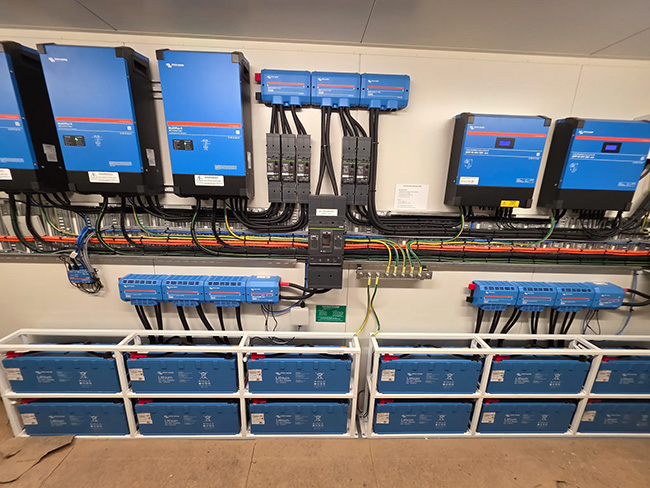
Power and water treatment in a single footprint.
The electrical wall is paired with a membrane-filtration water-treatment skid in the same 20-foot enclosure. Internal split-system air conditioning supports the commissioning environment before the unit heads to site.